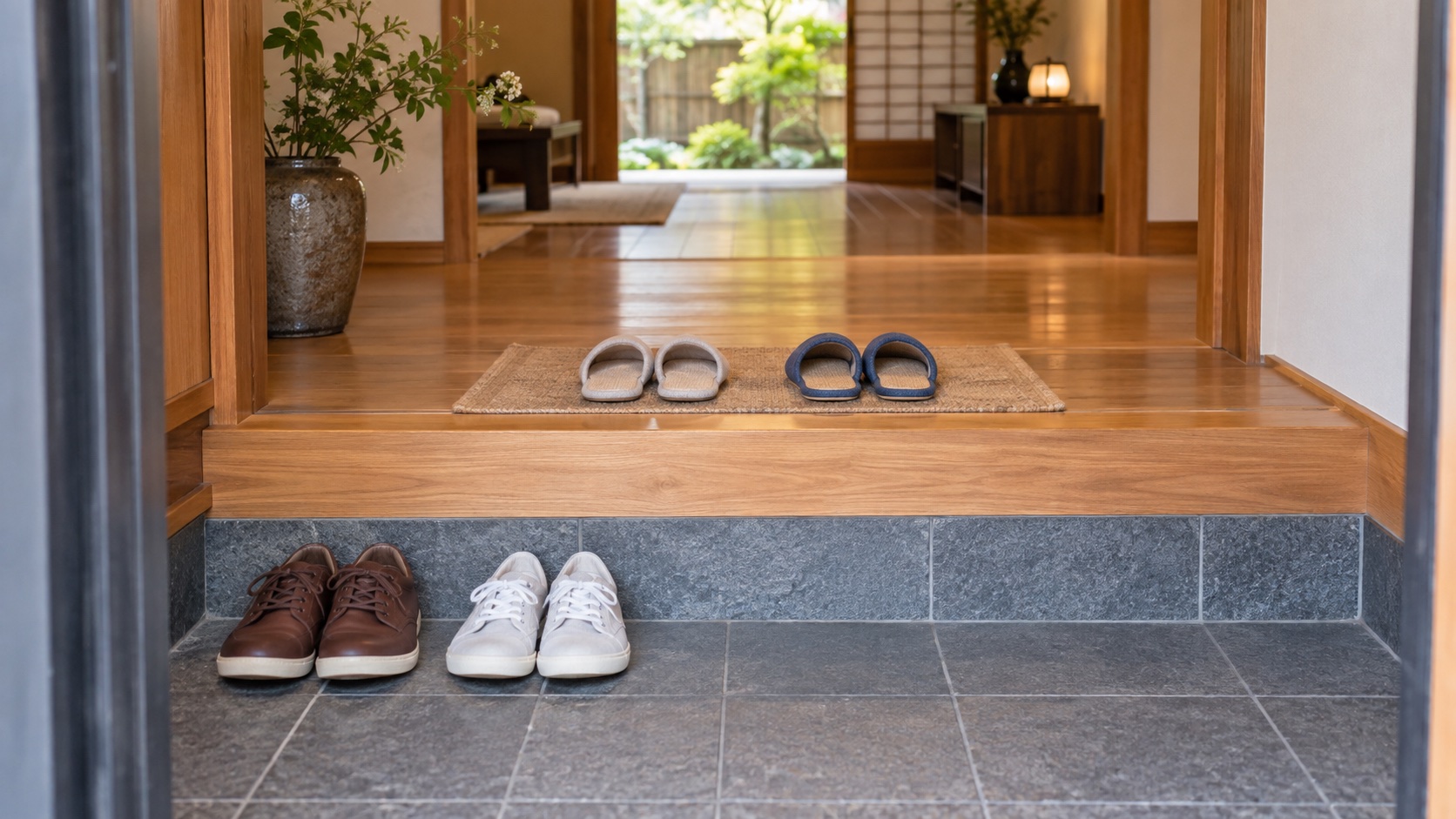
The safest rule is simple: when an entrance changes from a lower, harder floor to a raised, cleaner floor, stop before stepping up. Look for a shoe rack, lined-up shoes, slippers, or a sign. If you are still unsure, ask before crossing the boundary.
1. The quick rule
Outdoor shoes never cross onto the raised clean floor
Stand on the lower entry floor while removing your shoes. Turn toward the exit if space allows, step up in socks, then arrange your shoes neatly with the toes pointing toward the door. Follow the host or staff if the layout works differently.
2. Five visual clues that shoes should come off
- A raised floor: the most important clue. Tile, concrete, or stone below often marks the outdoor zone; wood, carpet, or tatami above marks the indoor zone.
- A shoe rack or lockers: empty shelves, numbered shoe lockers, or many pairs of shoes near the door tell you to stop.
- Slippers facing you: indoor slippers waiting beyond the threshold usually mean shoes come off first.
- Signs or pictograms: look for a crossed-out shoe, “Shoes Off,” 土足禁止, or 靴を脱いでください.
- What other guests are doing: observation is useful, but do not follow one distracted person over a clearly marked boundary.
3. How to use a genkan without stepping in the wrong place
- 1Stop on the lower floor
Do not step onto the raised floor in outdoor shoes, even for balance.
- 2Remove one shoe at a time
Keep your socked foot from touching the lower outdoor floor. Use a wall or handrail if provided.
- 3Step up in socks
Move fully onto the clean interior before arranging your shoes.
- 4Turn shoes toward the exit
Place them together neatly, or use the shelf or locker indicated by staff.
- 5Use slippers if offered
Slippers are usually optional in some homes and expected in others. Follow your host.
Wear clean socks without holes on days when you will visit homes, temples, castles, ryokan, or traditional restaurants. Bare feet are accepted in some casual settings, but socks feel more considerate on shared floors and tatami.
4. Places where you may need to remove shoes
| Place | What to expect | What to check |
|---|---|---|
| Private home | Almost always shoes off | Genkan step and host’s guidance |
| Ryokan | Often at the entrance or guest-room door | Property-specific slipper zones |
| Traditional restaurant | Sometimes before a tatami or raised seating area | Shoe lockers and staff directions |
| Temple, shrine building, castle | Sometimes for interior viewing | Signs, shoe bags, racks |
| Onsen or sento | Shoes off before the reception or changing area | Shoe-locker keys and floor boundary |
| Fitting room, clinic, school | Only where indicated | Slippers, staff instructions, signs |
Modern hotels, ordinary shops, cafés, and most Western-style restaurants keep outdoor shoes on. Never remove them simply because a place looks “Japanese”; read the entrance instead.
5. Indoor slippers, tatami, and toilet slippers
Indoor slippers belong only in their designated clean zone. Remove them before stepping onto tatami mats, where socks or bare feet are used. If a toilet has separate slippers, switch into them at the toilet door and leave them there when you exit. Accidentally walking through the building in toilet slippers is a classic visitor mistake.
Some slippers are one size and can feel loose. Take small steps, especially on stairs. If slippers are too small, ask rather than forcing them or walking in a way that could cause a fall.
6. Common mistakes and easy recoveries
- Socked foot touches the lower floor: step back, correct yourself, and continue. No dramatic apology is needed.
- Shoes cross the clean threshold: move them back immediately and say sumimasen.
- Slippers on tatami: remove them and leave them together at the mat’s edge.
- Toilet slippers worn outside: return them to the toilet as soon as you notice.
- No obvious storage: ask staff instead of blocking the entrance with shoes or carrying them through the building.
7. Useful Japanese
| Japanese | Pronunciation | Meaning |
|---|---|---|
| 靴は脱ぎますか? | Kutsu wa nugimasu ka? | Should I take off my shoes? |
| 靴はどこに置きますか? | Kutsu wa doko ni okimasu ka? | Where should I put my shoes? |
| スリッパを使いますか? | Surippa o tsukaimasu ka? | Should I use the slippers? |
| お邪魔します | Ojamashimasu | Polite phrase when entering someone’s home |
| すみません | Sumimasen | Excuse me / sorry |
8. Quick FAQ
Do I need to remove shoes in every temple?
No. Outdoor grounds are normally visited in shoes. Remove them only before an interior area where signs, racks, bags, or staff indicate it.
Can I go barefoot?
Rules vary. Clean socks are the safest choice for shared indoor floors, tatami, and formal visits.
What if I cannot bend down easily?
Ask for help or a chair. Many entrances provide a bench, rail, or shoehorn, and accessibility needs take priority over performing the routine perfectly.
Should I turn my shoes around before taking them off?
Do not twist awkwardly at the edge. Step up safely first, then turn and arrange them from the clean side without stepping back onto the lower floor in socks.
This guide was checked against the Japan National Tourism Organization’s official Japanese Customs and Etiquette and Japanese Manners Do’s and Don’ts. Entrances and accessibility arrangements vary, so current signs and staff instructions take priority.