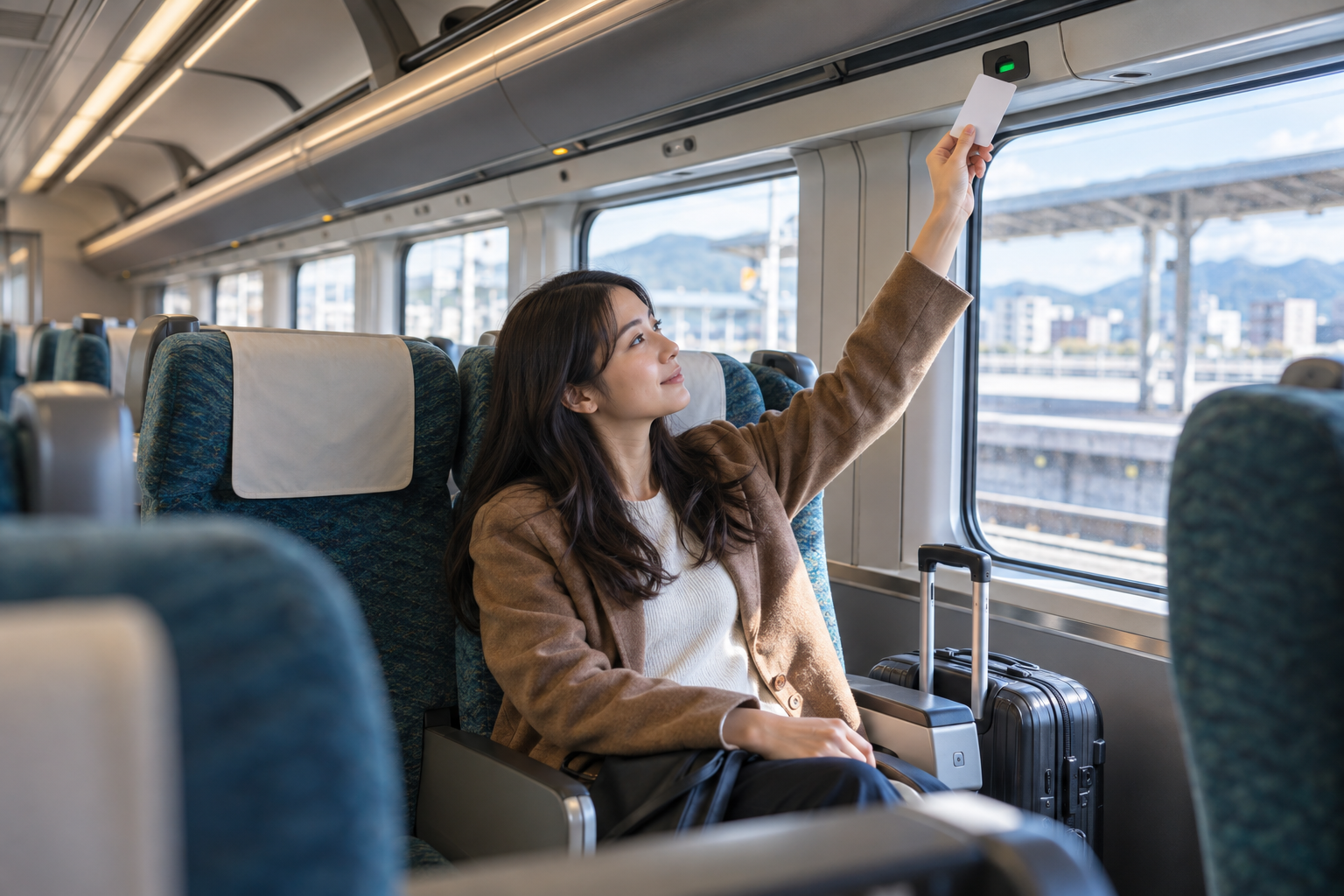
If you leave something on a Japanese train, tell railway staff as soon as possible. The most useful clues are the railway and line, direction of travel, time, boarding and exit stations, train destination, car number, where the item was placed, and a precise description of the item.
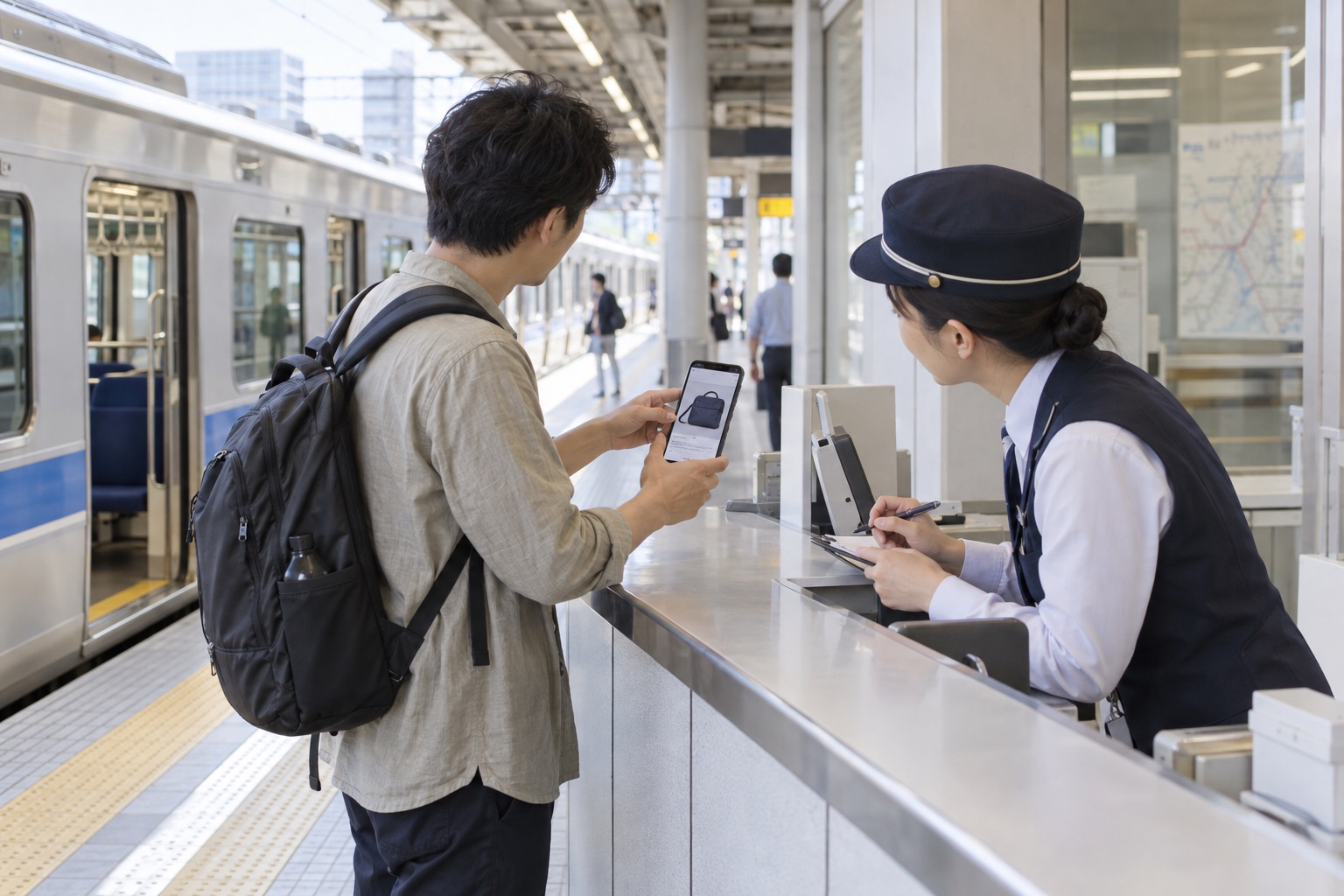
1. What to do in the first few minutes
- 1Go to the nearest station office
Tell staff immediately. If the train is still running, they may be able to contact a later station or the terminal.
- 2Do not board random trains to chase it
A train may change direction, line, or service pattern. Staff can identify its movement more reliably.
- 3Check your own bags once
Confirm the item is actually missing, but do not lose time repeatedly unpacking everything.
- 4Secure sensitive accounts
If a phone, wallet, or card is missing, begin remote locking and contact the card issuer while the railway search is underway.
Train and platform emergency devices are for immediate safety threats. Ask a crew member or station employee at the next safe opportunity.
2. Record the train details
Write everything down before memories blur. Screenshots from your route-planning app, IC card travel history, digital tickets, and photographs taken during the journey can help establish the time and train.
| Journey details | Item details |
|---|---|
| Railway company and line | Item type, color, size, and material |
| Direction and final destination shown | Brand and model, if known |
| Time you boarded and exited | Scratches, stickers, straps, or other marks |
| Boarding, transfer, and exit stations | Contents that only the owner should know |
| Express/local service and car number | A photograph of the same item |
| Seat, overhead rack, or door location | Serial number or device identifier |
JR East’s official lost-property page specifically asks for the date and time, stations and line used, likely location, and characteristics such as color, shape, material, maker, and contents. It also recommends preparing a photograph of the same item if you have one.
3. Contact the correct railway
Start with the company that operated the train—not simply the station building where you noticed the loss. Large stations can contain JR, subway, and private-railway areas managed by different organizations.
- Same day: ask the nearest station office or use the operator’s official lost-property channel.
- Later: use the railway’s official inquiry form, chat, telephone line, or lost-and-found center.
- No match yet: try again after some time. Items must be found, transported, and entered into a database before staff can match them.
- Multiple operators: submit accurate inquiries to each plausible company rather than assuming their systems are shared.
For example, JR East currently offers a 24-hour inquiry chat with replies handled during stated service hours, while Tokyo Metro directs same-day inquiries to a station office and later inquiries to its customer center or lost-and-found system. These are examples only; use the official page for the railway you rode.
4. Through-service trains can cross company lines
Many Japanese trains continue directly from one company’s tracks to another without making passengers transfer. A Tokyo Metro train, for example, may continue onto a JR, Tokyu, Tobu, Seibu, Odakyu, Sotetsu, Saitama Railway, or other partner line.
Your item may therefore end up at a distant terminal or in another company’s custody. Tokyo Metro explicitly asks passengers to contact the connecting operator as well for items left on through-service trains. Tell staff the destination displayed on the train and every line used.
5. If it was a phone, wallet, passport, or medicine
| Item | Action while you search |
|---|---|
| Phone or tablet | Use the manufacturer’s official lost-device service, lock the screen, display safe contact details, and suspend the SIM if needed. Do not confront anyone based only on a map pin. |
| Wallet or cards | Freeze or cancel payment cards and notify the issuer. Record which IDs and cards were inside. |
| Passport | Contact the railway and police, then contact your embassy or consulate for replacement instructions. Do not wait until departure day. |
| Essential medicine | Tell staff it is medically important, then contact a clinic or pharmacy for professional advice rather than missing necessary treatment. |
| Keys with an address | Contact your accommodation or building manager and consider changing access arrangements. |
6. File a lost-property report when appropriate
The Tokyo Metropolitan Police Department advises people who lose property on a train to contact the railway and file a Lost Property Report at a police station or koban (police box). This is especially important for passports, identification, wallets, valuable electronics, suspected theft, and insurance documentation.
A police report does not replace the railway inquiry. Railway companies usually hold items for a limited period before transferring unclaimed property to police, and the timing differs by operator and item.
Describe what you know without accusing someone. If you witnessed theft or face an immediate danger, tell police clearly. Use Japan’s emergency number 110 only for an active emergency, not a routine property inquiry.
7. Collecting your item
Wait until the operator confirms the storage location. Found property may move from a station to a central office and later to police, so going to a terminal without confirmation can waste time.
- Bring a passport or other official photo identification.
- Bring the inquiry or reference number and the message identifying the collection point.
- Be ready to describe private contents or unlock the device.
- Check opening hours and the final collection date.
- Ask in advance about collection by another person, delivery, postage, or required authorization.
Do not publish a full serial number, passport number, lock-screen code, or every private identifying detail on social media. Give those details directly to the railway or police.
8. Useful Japanese
| Japanese | Pronunciation | Meaning |
|---|---|---|
| 電車に忘れ物をしました | Densha ni wasuremono o shimashita | I left something on the train. |
| 黒いかばんです | Kuroi kaban desu | It is a black bag. |
| 網棚に置きました | Amidana ni okimashita | I put it on the overhead rack. |
| この電車です | Kono densha desu | It was this train. |
| どこで受け取れますか? | Doko de uketoremasu ka? | Where can I collect it? |
| 遺失届を出したいです | Ishitsutodoke o dashitai desu | I would like to file a lost-property report. |
9. Quick FAQ
Should I wait until tomorrow to report it?
No. Report it immediately, then follow up later if there is no match. Database registration can take time.
Will every railway search the same database?
No. Systems and custody can be separate, especially on through-service routes. Contact every plausible operator.
Can the item be sent to my hotel or home?
Sometimes, depending on the operator, item, destination, and identification process. Shipping may be cash-on-delivery and some items cannot be sent. Ask the custodian after the item is identified.
What if I already left Japan?
Continue with the operator or police office holding the item. Ask whether an authorized representative or supported delivery method is possible; rules and costs vary.
This is original editorial content and does not reproduce railway maps, forms, photographs, or logos. The search checklist and JR example were checked against JR East’s official lost-property guide. Same-day, through-service, storage, and collection guidance was checked against Tokyo Metro’s Lost & Found page. Police-report guidance was checked against the Tokyo Metropolitan Police Department. Procedures, telephone numbers, storage periods, and office hours may change; use the current page for the operator involved.