Japanese toilets range from simple fixtures to heated seats with warm-water cleansing. For a first visit, remember four things: sit down before testing the wash buttons, start with low water pressure, press the stop symbol when finished, and locate the separate flush control before leaving.
1. The quick start
- 1Lock the door and sit down
Many wash functions use a seat sensor and will not operate unless someone is seated.
- 2Use the toilet normally
Toilet paper is provided in most public facilities. Use only the amount you need.
- 3Try the wash function if you want
Choose rear or front cleansing and begin with the lowest water-pressure setting.
- 4Press stop
The square stop symbol or a button marked 止 ends the spray. Do this before standing.
- 5Dry and flush
Use toilet paper or a dryer if fitted, then use the lever, wall button, sensor, or control specifically marked for flushing.
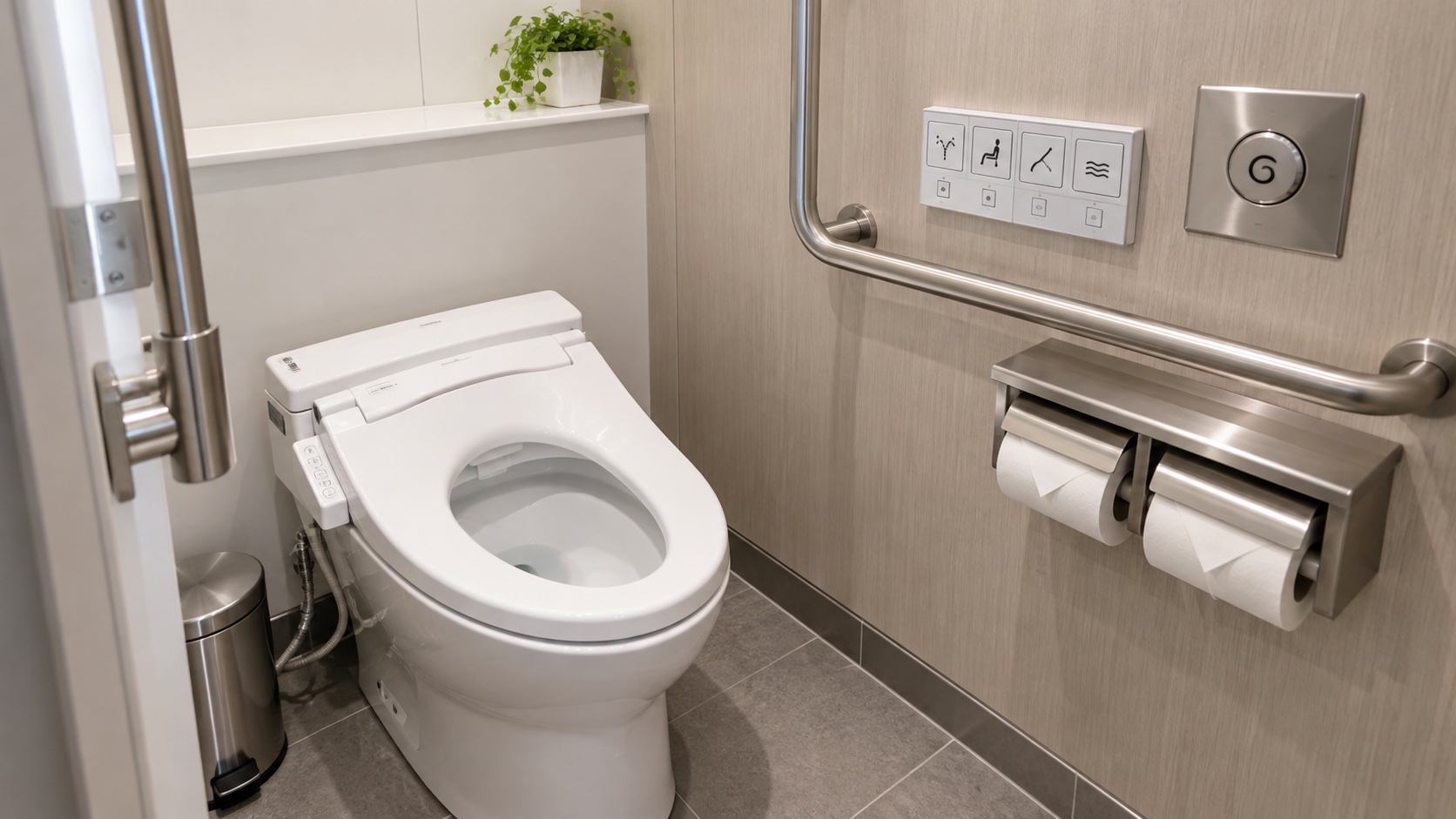
A button with a musical note or speaker symbol may play a privacy sound, sometimes called Otohime. Look separately for a flush symbol, lever, sensor, or the characters 流す.
2. How to use a warm-water bidet seat
“Washlet” is TOTO’s trademark, while other manufacturers use names such as shower toilet or bidet seat. Travelers often use “washlet” as a general term. The basic operation is similar: a concealed wand extends, sprays warm water, then retracts and cleans itself.
You do not need to use the spray. The toilet works normally without it. If you do try it, remain seated, keep clothing clear, select the gentlest pressure, and use the position control only after you understand the main buttons. Press stop if anything feels uncomfortable.
3. Common buttons and pictograms
| Symbol or label | Japanese | Function |
|---|---|---|
| Square stop symbol | 止 | Stops washing or drying |
| Rear-spray pictogram | おしり | Rear cleansing |
| Front-spray pictogram | ビデ | Gentler front cleansing |
| Plus / minus or bars | 水勢 | Water-pressure adjustment |
| Air or wavy lines | 乾燥 | Warm-air dryer, if fitted |
| Musical note / speaker | 音 | Privacy sound; not a flush |
| Flush symbol | 流す | Flushes the bowl |
Layouts vary widely. Do not press a red emergency button or pull an emergency cord to test it. Those controls are for someone who has fallen or needs urgent assistance.
4. How to find the flush
The flush may be a lever on the tank, a button on the wall, a sensor you hold your hand over, or part of the electronic control panel. The characters 大 and 小 mean full and light flush. Some toilets flush automatically after you stand.
If nothing happens, look behind the toilet and beside the paper holder before pressing unfamiliar buttons. In an older facility, a pedal may be near the floor. Ask for help if necessary rather than forcing a control.
5. Public restroom manners
- Join the line: follow any floor markings and use the next suitable open stall.
- Give priority where needed: accessible and family facilities are essential for some users. Use an ordinary stall when you can.
- Flush toilet paper only: place sanitary products, diapers, wipes, and other waste in the appropriate bin.
- Leave the seat and floor clean: wipe small splashes if supplies are provided, and tell staff about a serious problem.
- Keep privacy: do not photograph inside an occupied restroom or include other users in photos.
- Do not linger: busy station and attraction toilets may have long queues.
- Wash and dry your hands: soap or dryers may occasionally be unavailable, so carrying tissues and sanitizer is useful.
Large train stations, department stores, shopping centers, museums, parks, and convenience stores often have toilets, but access rules differ. In a small café or shop, ask before heading past the customer area.
6. Accessible and multipurpose toilets
Many public facilities provide a larger multipurpose toilet with grab bars, space for a wheelchair, and sometimes an ostomate sink, adult changing board, or child seat. Doors may open by button and close separately, so confirm that the door is locked.
Emergency buttons and cords may be positioned near the toilet and close to the floor. Their placement helps a person call for assistance after a fall. They are not flush controls. If you activate one accidentally, contact staff and explain rather than leaving silently.
7. If you find a squat toilet
Traditional squat toilets are less common but still appear in some stations, parks, and older buildings. Face the raised hood, place one foot on each side of the fixture, lower into a stable squat, and keep clothing clear. Use the handrail if provided. Flush with the nearby lever, pedal, or button.
If mobility, balance, pregnancy, clothing, or luggage makes this unsafe, choose a Western-style or accessible stall. There is no etiquette benefit to using a fixture that is not suitable for you.
8. Quick FAQ
Are public toilets free in Japan?
Many toilets in stations, parks, shopping facilities, and tourist sites are free to use, though you may need a train ticket or facility access in some locations.
Can toilet paper go in the toilet?
Yes, ordinary toilet paper is designed to be flushed. Do not flush wet wipes, sanitary products, diapers, or other trash.
Will the spray turn on while I am standing?
Many modern seats have a sensor and will not spray unless you are seated, but never rely on that as a test. Sit down before using wash controls.
What if the labels are only in Japanese?
Use the standard pictograms, a translation app, or skip the optional wash functions. You only need to locate the flush.
This guide was checked against the Japan National Tourism Organization’s overview of Japanese toilets and universal design, TOTO’s explanation of warm-water cleansing, and TOTO’s official basic operation guide. Controls differ by model; follow the pictograms and instructions on the toilet you are using.