You do not need to drag a suitcase through every station, temple, and shopping street in Japan. For a few hours, use a coin locker or staffed baggage counter. For travel between cities, a luggage-delivery service can send your suitcase to your next hotel or the airport while you travel with a small overnight bag.
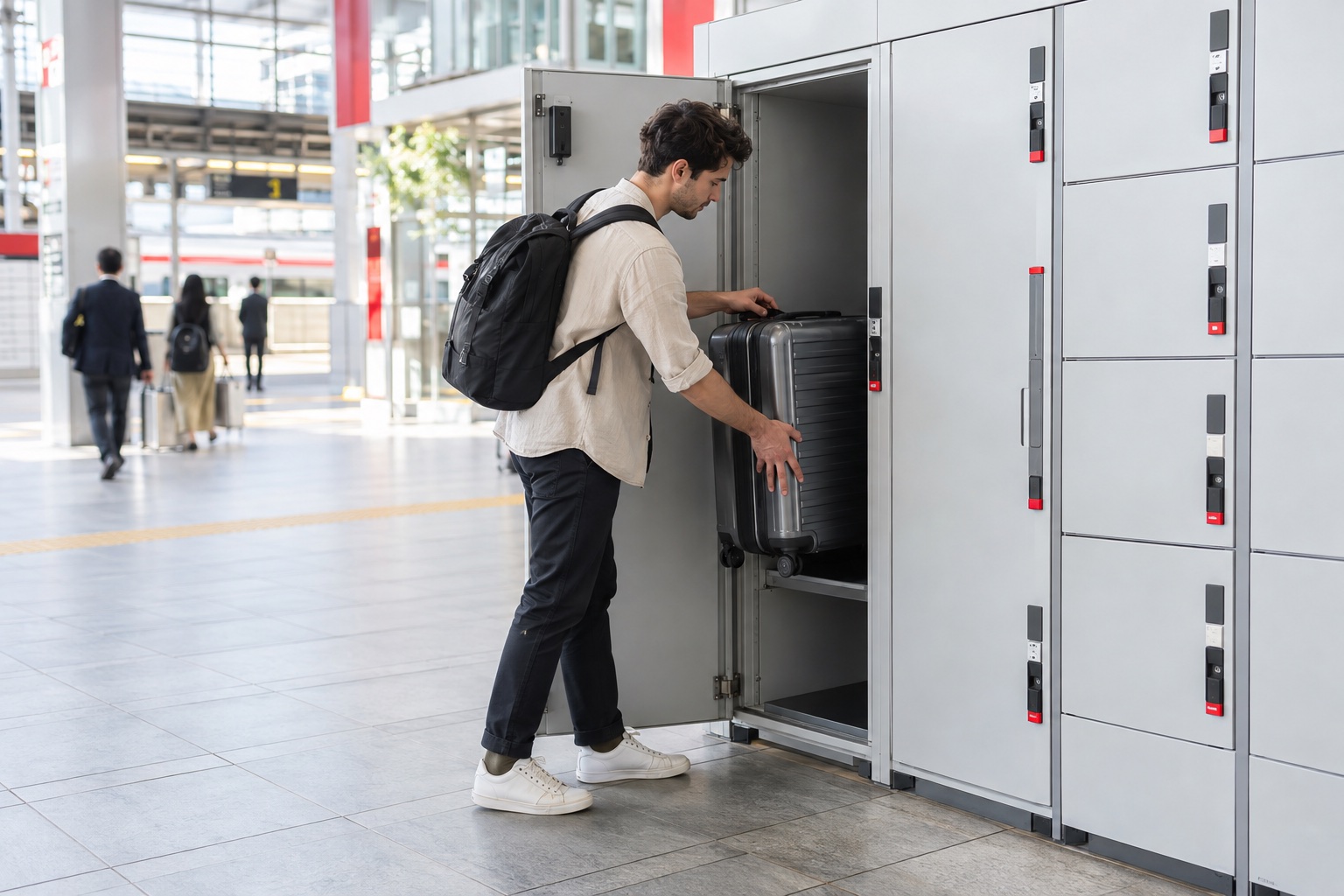
1. Which option should you use?
| Option | Best for | Main limitation |
|---|---|---|
| Station coin locker | A few hours near the same station | Large lockers fill quickly; you must return to that exact bank |
| Staffed baggage storage | Oversize bags, full lockers, or personal assistance | Collection is limited to the counter's opening hours |
| Airport storage | A layover, early arrival, or several days without one bag | Terminal and security-side location matter |
| Luggage delivery | Hotel-to-hotel or hotel-to-airport travel | Not instant; cutoff times and eligible destinations vary |
Store locally when you are coming back; ship ahead when you are moving on
If you will return to the same station today, a locker is usually simplest. If your next stop is another city, forwarding the large suitcase can save you from carrying it on stairs, local trains, and crowded platforms.
2. Finding coin lockers at a station
Major stations often have several separate locker areas. Look for a suitcase or key symbol on station maps and signs, or ask at an information counter. In Japanese, coin locker is written コインロッカー.
Check whether a locker is inside or outside the ticket gates. A locker inside the paid area may require a valid ticket or fare adjustment when you return. At a large station, similar-looking locker banks can be hundreds of meters apart.
- Photograph the locker bank, nearby exit number, and floor.
- Save the station name and whether it is inside or outside the gates.
- Check that the station will still be open when you return.
- Use the smallest locker that fits without forcing the door.
- Keep any receipt, PIN, key, or payment card with you.
If every large locker beside the main entrance is occupied, check another exit, a different floor, or a nearby station. Do not spend half an hour circling a huge station when a staffed storage counter is available.
3. How to use a station coin locker
Some lockers use a physical key; others use a central touchscreen, a transport IC card, a QR code, or a printed PIN. Read the instructions on the exact unit rather than assuming every locker works the same way.
Key-operated locker
- 1Check the price and available period
Confirm when another charge begins and the maximum storage period.
- 2Put your bag inside
Close the door gently. Move to a larger locker if it does not close.
- 3Insert the required coins
Many traditional lockers accept ¥100 coins, but payment methods vary.
- 4Turn and remove the key
Check that the door is locked and keep the numbered key secure.
- 5Return to the same locker
Pay any additional fee, unlock the door, and check the compartment before leaving.
Touchscreen or IC-card locker
- 1Place the bag in an available locker
Close the door and use the central screen for that bank.
- 2Select the locker and pay
If you use an accepted IC card, that same card may become the key. Cash payment may produce a receipt with a PIN or QR code.
- 3Save the receipt
Keep the paper and photograph it privately so no one else can read the code.
- 4Select retrieval when you return
Tap the same IC card or enter the requested code, then pay any extra fee.
If the card was used to lock the door, you may need that exact card to open it. Keep it with your phone, passport, medicine, tickets, and other essentials.
4. Fees, time limits, and restricted items
Prices depend on location and size. More importantly, each machine defines its charging period differently. Some airport lockers charge until midnight; others use a set number of hours. A new fee can therefore begin sooner than expected. Read the price panel before paying.
Maximum storage periods also vary. Once the limit passes, the operator may remove the bag to another location and add handling or storage fees. A coin locker is not long-term storage.
Keep your passport, wallet, medication, travel documents, essential electronics, keys, and valuables with you. Operators commonly restrict cash, dangerous goods, living animals, perishables, fragile objects, and anything that may leak or cause damage.
As a current example, Narita's official page lists standard daily lockers at ¥400, ¥600, and ¥800 by size, while some locations use hourly pricing. Haneda publishes a different schedule. These are airport examples—not nationwide prices—and can change.
5. When staffed baggage storage is better
Choose a staffed counter when your suitcase does not fit, large lockers are full, or you need help. Stations, airports, bus terminals, department stores, and tourist-information centers may offer temporary storage.
- Confirm the final collection time, not just the building's closing time.
- Ask whether the fee is per item, calendar day, or 24-hour period.
- Check maximum dimensions, weight, and storage period.
- Ask whether you may reopen the bag during storage.
- Find out what happens if you miss the collection deadline.
Keep the claim ticket and photograph it. Allow extra time at pickup because queues form before last trains and around airport departure peaks.
6. Coin lockers and storage counters at airports
Airports usually offer both lockers and staffed storage, but facilities differ by terminal and may be before security. Confirm your airline's terminal first; returning to another terminal can take longer than expected.
| Situation | Practical choice |
|---|---|
| Several-hour layover | Use a locker or counter in your departure terminal |
| Large or unusual luggage | Ask a counter; acceptance depends on size, weight, and shape |
| Early arrival before check-in | Ask about same-day delivery to an eligible hotel |
| Sending a bag for departure | Ship it early and confirm the airport counter, terminal, and pickup deadline |
Narita publishes separate live pages for lockers, storage, and delivery in Terminals 1–3. Haneda lists facilities by terminal; its current official information says all coin lockers are outside the gate. Use official maps instead of relying on an old blog screenshot.
7. Luggage delivery between hotels and airports
Luggage forwarding is often called takkyubin or takuhaibin. Yamato Transport and Sagawa operate services for travelers. Depending on the location and service, luggage may be sent to a hotel, airport counter, carrier office, or other supported destination.
- 1Ask the receiving location first
Confirm that your next hotel has a staffed front desk and accepts luggage before check-in. Unstaffed vacation rentals may not qualify.
- 2Confirm the delivery date
Show the full address and reservation name. Ask how many days are needed instead of assuming next-day delivery.
- 3Pack an overnight bag
Keep clothes, medicine, chargers, travel documents, and anything needed before delivery.
- 4Complete the waybill carefully
Use the hotel reservation name and provide a reachable phone number when requested.
- 5Keep the receipt and tracking number
Photograph both before leaving the counter.
Airport delivery normally has an earlier deadline than ordinary hotel delivery. Weather, traffic, remote destinations, and peak periods can cause delays. Confirm the lead time and carry all flight essentials.
Hotel policies vary. Yamato's official guidance says its usual hotel workflow cannot deliver to Airbnb-style accommodation without reception staff. Sagawa likewise notes that same-day hotel delivery is limited to eligible areas and cannot serve unmanned accommodation.
8. Three useful luggage plans
After checkout, explore the same city
First ask whether your hotel will hold luggage. If not, use a locker near the station where you will depart—not simply the station closest to the hotel.
Tokyo → one night in Hakone → Kyoto
Send the large suitcase from Tokyo to Kyoto, then take a small overnight bag to Hakone. Confirm the delivery date and make sure the Kyoto hotel will accept it.
Last hotel → airport
Confirm how early to send the bag, which terminal counter will hold it, and what is required at pickup. Keep your passport, medication, flight documents, and a change of clothes.
9. Useful Japanese phrases
| Japanese | Pronunciation | Meaning |
|---|---|---|
| コインロッカーはどこですか? | Koin rokkā wa doko desu ka? | Where are the coin lockers? |
| 大きいロッカーは空いていますか? | Ōkii rokkā wa aite imasu ka? | Is a large locker available? |
| 荷物を預けられますか? | Nimotsu o azukeraremasu ka? | Can you store my luggage? |
| 何時までに戻ればいいですか? | Nanji made ni modoreba ii desu ka? | What time must I return? |
| このホテルへ送れますか? | Kono hoteru e okuremasu ka? | Can you send this to this hotel? |
| いつ届きますか? | Itsu todokimasu ka? | When will it arrive? |
10. Quick FAQ
Do lockers accept Suica or PASMO?
Many touchscreen lockers accept transport IC cards, but not every machine does. Check the logos. When an IC card is the key, keep that same card until retrieval.
What if I lose the key or receipt?
Contact the operator using the instructions on the locker bank. You may need identification, a description of the contents, and a handling fee. Never force the door.
Can I reserve a locker?
Some smart-locker networks offer searches and reservations, but ordinary station lockers are often first come, first served. Narita lists reservations for selected MULTIECUBE lockers.
Will my hotel hold luggage?
Many staffed hotels do, but it is not universal. Ask directly, especially at small hotels, hostels, capsule hotels, and unmanned accommodation.
Can I send luggage from a convenience store?
Some stores accept domestic parcels, but service, payment, packaging, size limits, and airport deadlines vary. A staffed hotel or carrier counter is easier for a first-time visitor.
Is delivery guaranteed to arrive on time?
No service is immune to weather, traffic, disruption, or address problems. Build in extra time and carry anything you cannot be without.
This is original editorial content. It paraphrases operational information instead of reproducing third-party articles or photographs. Check live details at Narita Airport coin lockers, Narita baggage storage, Haneda Airport coin lockers, and Haneda baggage storage. For delivery options, see Yamato Hands-Free Travel and Sagawa Hands-Free Travel. Fees, hours, eligible hotels, accepted items, and delivery times can change.